
Capital is the oxygen your business needs to survive.
To scale, you need a massive influx of cash.
Whether you are a manufacturing unit looking to buy heavy machinery, or a trading company expanding your inventory, cash flow bottlenecks can kill your momentum.
Unsecured business loans are fast, but they come with high interest rates and short repayment tenures.
So, what is the smart money move for growing SMEs?
The answer is a Business Loan Against Property (LAP).
By leveraging the real estate you already own, you can unlock unparalleled financial power.
Welcome to the Growmore Finance definitive guide to scaling your business with secured debt.
In this guide, we will break down how to get approved, how to maximize your loan amount, and how to avoid the hidden traps that bankrupt unprepared business owners.
Let’s unlock your capital.
What Exactly is a Business Loan Against Property (LAP)?
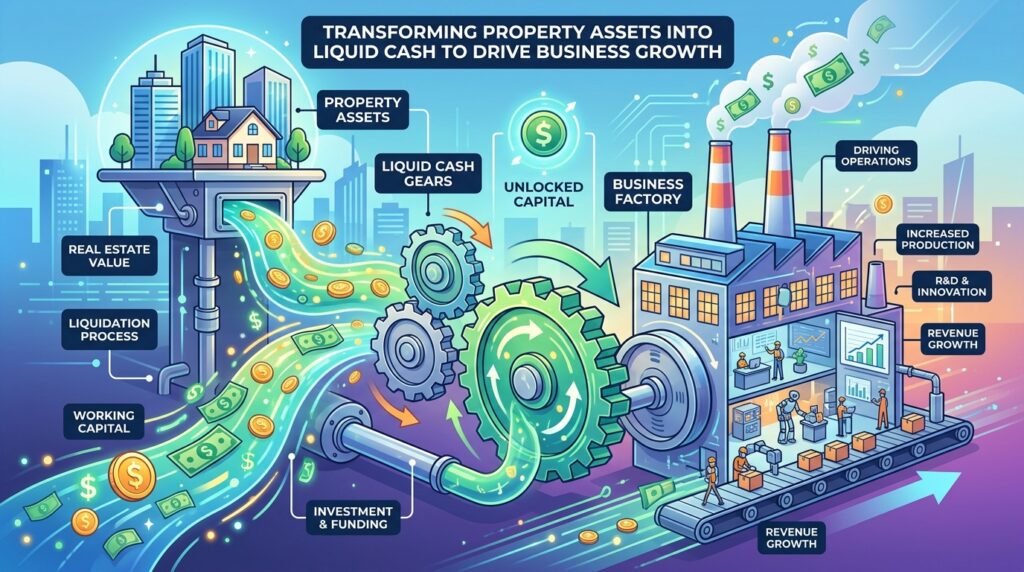
A Business LAP is a secured loan where you pledge your commercial, residential, or industrial property as collateral.
In return, the lender provides you with a high-value loan at a significantly lower interest rate than an unsecured loan.
You continue to use your property normally.
You retain full ownership.
The bank simply holds the original title deeds as a security measure until the loan is fully repaid.
It is the ultimate way to make your dead real estate assets work for your active business operations.
Why SMEs Must Choose LAP Over Unsecured Business Loans
If you need a small, quick injection of ₹5 Lakhs, an unsecured loan makes sense.
But if you are planning serious growth, a Business Loan Against Property is vastly superior. Here is why:
1. Drastically Lower Interest Rates
Unsecured business loans often charge interest rates ranging from 14% to 24%. Because a LAP is backed by collateral, lenders view it as low-risk. This means you can secure interest rates starting as low as 8.5% to 10.5%.
2. Massive Loan Amounts
Unsecured loans usually cap out at ₹50 Lakhs. With a LAP, your loan amount is directly tied to the value of your real estate. Depending on the lender, you can secure anywhere from ₹50 Lakhs to ₹50 Crores.
3. Longer Repayment Tenures
Unsecured loans demand aggressive repayment, typically within 12 to 36 months. This drains your monthly cash flow. A LAP offers comfortable tenures ranging from 10 to 15 years, keeping your EMI exceptionally manageable.
The Growth Secret: Mortgage Loans Up to 100% of Property Value
Most traditional lenders offer a Loan-to-Value (LTV) ratio of 60% to 70%.
This means if your property is worth ₹1 Crore, you get a loan of ₹65 Lakhs.
However, the modern lending landscape has evolved for aggressive SME growth.
Through strategic financial structuring, top-tier lenders now offer mortgage loans up to 100% of your property’s value.
This is a game-changer for high-revenue businesses that have excellent cash flows but limited physical real estate.
If your financials are rock solid, you can extract every single rupee of equity trapped in your real estate.
Click Here👉👉 maximizing-loan-to-value-ratio-guide ( LTV )
How Regional SMEs are Using LAP to Dominate Markets
Different businesses require capital for different reasons.
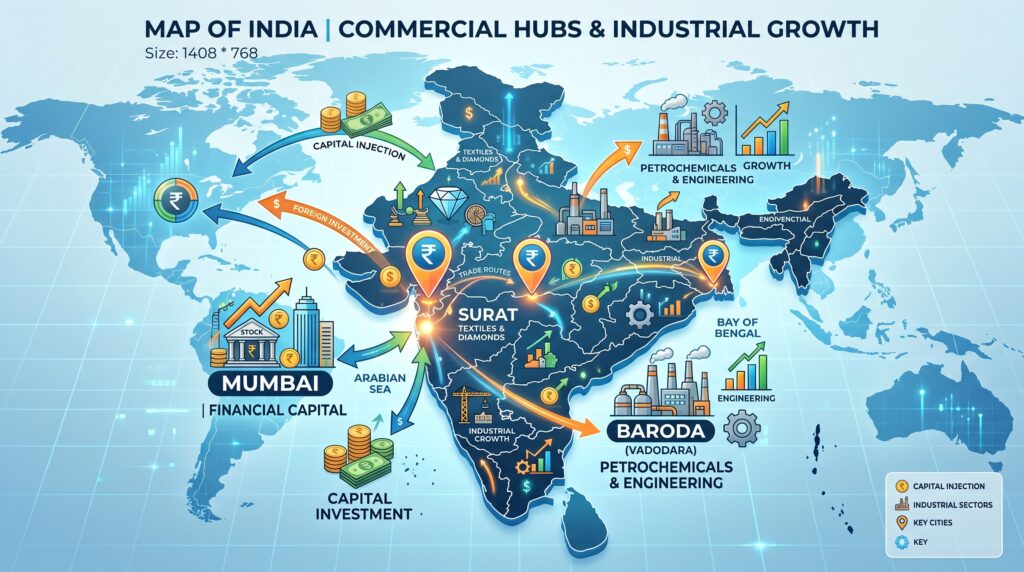
Here is how smart SME owners across major commercial hubs are deploying LAP funds:
Surat: Textile and diamond manufacturers are using LAP to upgrade to advanced, imported machinery without draining their daily operational cash.
Vapi: Chemical and industrial plant owners are leveraging factory land to fund strict environmental compliance upgrades and expand facility footprints.
Mumbai: Trading houses and export-import firms are using high-value commercial property LAPs to secure massive working capital for international bulk orders.
Baroda: Engineering SMEs are using collateral-backed loans to bridge the gap between delivering a major government contract and receiving the actual payment.
When you use cheap debt to fund high-ROI activities, your business scales exponentially.
The Secret to Approval: Mastering Your Average Bank Balance (ABB)
Having a valuable property is not enough to get a LAP.
Lenders do not want to seize your property; they want you to pay the EMI.
To prove you can pay the EMI, lenders heavily scrutinize your bank statements.
The most critical metric they look at is your Average Bank Balance (ABB).
Why a 1-Year ABB Analysis is Non-Negotiable
Many business owners scramble to inflate their bank accounts a month before applying for a loan. Lenders see right through this. Banks and NBFCs require a strict, month-wise analysis of your ABB over a continuous 1-year period (e.g., January 2025 to January 2026).
They want to see consistent cash flow, not artificial spikes.
Actionable Insights for Bank Statement Management
Stop Cash Hoarding: Deposit all business cash into your current account immediately.
Maintain the Minimum: Never let your balance dip below your projected future EMI amount.
Avoid Cheque Bounces: A single bounced cheque (inward or outward) in a 12-month period can destroy your loan eligibility.
Essential Documentation for Business LAP
Do not let paperwork delay your capital injection. Keep this file ready:
Property Documents
Original Title Deeds (Registered Sale Deed/Conveyance).
Latest Property Tax Receipts.
Approved Building Plan and Occupancy Certificate.
Society NOC (if applicable).
Business & Financial Documents
GST Registration Certificate & Udyam Aadhar.
Last 3 Years Income Tax Returns (ITR) with Computation of Income.
Audited Balance Sheet and Profit & Loss Statement.
Last 12 Months Bank Statements (Current & Savings).
KYC Documents of all Directors/Partners
Are There Tax Benefits on a Business Loan Against Property?
Yes, but they work differently than a standard home loan.
You cannot claim deductions under Section 80C for the principal repayment of a LAP.
However, you can absolutely claim the interest paid as a legitimate business expense.
Under the Income Tax Act, if the LAP funds are utilized strictly for business purposes, the entire interest component can be deducted from your gross business profit.
This significantly lowers your total corporate tax liability.
(Always consult with your chartered accountant to ensure proper documentation of the end-use of funds).
Common Mistakes SMEs Make When Applying for a LAP
Avoid these deadly errors that lead to instant rejections:
1. Pledging Disputed Property
If your property has multiple legal heirs and no clear partition deed, banks will not touch it. Ensure your title is 100% clear.
2. Ignoring Personal CIBIL Scores
Your business might be booming, but if your personal CIBIL score is below 700 due to a forgotten credit card bill, your Business LAP will be rejected.
3. Commingling Personal and Business Funds
Using your current account for personal grocery shopping, or your savings account for vendor payments, creates an accounting nightmare. Lenders hate messy books.
4. Applying at Multiple Banks Simultaneously
Every time a bank checks your CIBIL score for a loan inquiry, it causes a “hard pull.” Multiple hard pulls in a short time will crash your credit score.
Expert Tips: Best Practices for Maximum Valuation
At Growmore Finance, we know exactly how bank valuers operate.
To get the highest possible loan amount, follow these insider tips:
Complete Pending Maintenance: A freshly painted property with no structural defects gets a higher valuation report.
Regularize Unauthorized Construction: If you have built an extra shed without municipal approval, it will not be counted in the property value. Get it approved.
Highlight the Location: If your property is near an upcoming metro station or highway project in Gujarat or Maharashtra, explicitly point this out to the bank’s technical valuer.
Click Here👉👉 Ministry of MSME – Official Guidelines for SME Financing
The Ultimate Checklist for Business Loan Seekers
Before you sign any loan agreement, check off these mandatory steps:
[✔️] Calculated exact working capital required vs. property value.
[✔️] Maintained a clean 1-year Monthly Average Bank Balance (ABB).
[✔️] Verified that your CIBIL score is above 750.
[✔️] Ensured all property documents are legally clear and updated.
[✔️] Compared processing fees and foreclosure charges across three different lenders.
Conclusion & Next Steps
A Business Loan Against Property is the most powerful financial lever an SME owner can pull.
It provides massive capital, highly affordable interest rates, and flexible repayment tenures.
By understanding the importance of your 1-year average bank balance, keeping your property titles clear, and leveraging up to 100% of your property’s value, you can outpace your competitors and dominate your local market.
Do not let a lack of funding stall your vision. Your property is a sleeping giant—it is time to wake it up.
Ready to Scale Your Business Today?
Why navigate complex bank policies alone?
Get expert guidance on securing the maximum loan amount at the lowest interest rate. Whether you need to fund a new factory in Vapi or expand operations in Mumbai, we make the process seamless.
Contact Growmore Finance instantly at Coll Now Click 👉👉7567009947 for a Free Loan Eligibility Check!
Want more insider financial strategies?
Subscribe to our blog to master corporate finance, tax planning, and real estate leveraging.
hi